

A few cracks in a concrete driveway do not automatically mean the whole thing needs to be removed. Concrete lives outside, carries heavy vehicles, and goes through years of heat, cold, rain, and freeze-thaw cycles. Some wear is normal.
There is a point, however, where repeated patching stops being a real solution. When large areas are breaking apart, slabs are moving, edges are crumbling, or drainage problems keep creating new damage, replacement can make more sense than continuing to repair one section at a time.
Look at the Whole Driveway, Not Just the Worst Crack
The condition of the full slab usually tells more than one damaged spot. A single crack may be manageable. Several problems happening at once are different.
Homeowners should look for multiple cracks traveling in different directions, sections that have dropped or lifted, broken corners, wide gaps, standing water, and areas that continue to deteriorate after previous repairs.

It is also important to look at how the driveway meets the garage, sidewalk, yard, and street. A slab that has moved can create abrupt transitions that are hard on vehicles and people. Water can collect against those low spots and make the problem worse.
Replacement Creates a Chance to Fix More Than Appearance
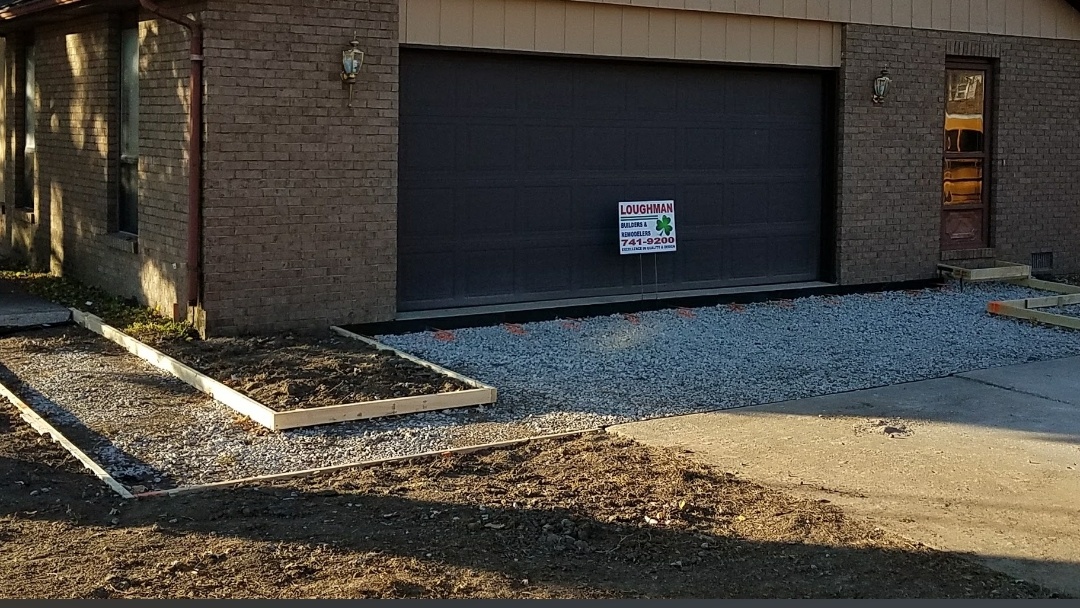
A new driveway obviously improves curb appeal, but the bigger opportunity is correcting the underlying setup. Removing the old concrete exposes the base and gives the contractor a chance to address grading, support, and drainage before the new slab is placed.

That preparation matters because the finished concrete is only as good as what supports it. A beautiful surface placed over poor conditions can develop problems sooner than expected.
Common Signs Replacement May Be the Better Option
- Large areas of interconnected cracking
- Sunken or raised slabs that create uneven transitions
- Broken edges and corners throughout the driveway
- Major surface deterioration over a wide area
- Water collecting because the slab no longer drains properly
- Repeated patches that continue to fail
- Damage that affects the approach to the garage or sidewalk
Why Drainage Deserves Attention
Water is one of the biggest enemies of exterior concrete. If runoff collects beside or beneath the slab, seasonal freezing and thawing can contribute to movement. Poor drainage can also direct water toward the garage, foundation, or nearby walkways.
A driveway replacement should consider where water is coming from and where it needs to go. That does not mean every property needs a complicated drainage system, but the finished grade should make sense for the site.
Concrete Is Part of the Whole Property
Driveways do not exist by themselves. They connect to sidewalks, steps, garage floors, street approaches, landscaping, and sometimes patios or other hard surfaces. That is why a contractor should look at the entire area before deciding how to approach the replacement.
Loughman Builders & Remodelers handles broad home repair and improvement work throughout Belleville and the Metro-East. That whole-property view is useful because exterior repairs often interact with other parts of the home.
Repair Versus Replacement Is Usually About Scale
Homeowners often ask whether a damaged driveway can simply be patched. Sometimes it can. The question is whether the damage is isolated or whether it reflects movement across a larger area.
If one corner has chipped but the rest of the driveway is stable, a localized repair may be reasonable. If several slabs are cracked, settled, or separating, patching one section may only improve appearance temporarily.
The more widespread the movement, the more important it becomes to evaluate the base and drainage instead of concentrating only on the visible surface.
Think About Long-Term Use Before the Pour
A driveway replacement is also a chance to think about how the property is used today. Vehicle size, parking patterns, turning room, garage access, and sidewalk connections may be different from when the original driveway was installed.
That does not always mean changing the layout, but it is worth considering before new concrete locks the current arrangement in place for years.
Before-and-After Should Also Mean Problem-and-Solution
The final photo matters, but appearance is only one measure of a successful driveway project. The goal is a surface that fits the home, supports everyday vehicle use, drains reasonably, and replaces concrete that has moved beyond practical repair.
Homeowners can browse Loughman’s project portfolio to see examples of real work and review the company’s broader construction and remodeling services.
If your driveway has reached the point where patching is just buying time, contact Loughman Builders & Remodelers to discuss the condition of the concrete and the best next step.